Medically reviewed by Dr. Yuvrajsingh Jadeja, MBBS, MD (Obstetrics & Gynaecology), Medical Director, Nimaaya Women’s Centre for Health & IVF Centre
Surrogacy in India is legal but strictly regulated. Indian law permits only altruistic gestational surrogacy for eligible intending couples or intending women who have a qualifying medical indication. Commercial surrogacy, in which a surrogate is paid a fee for carrying the pregnancy, is prohibited.
To proceed legally, the intended parent(s) must meet the eligibility requirements, obtain the required medical certification and approvals, and work with a registered surrogacy clinic. The surrogate must be a willing, ever-married woman aged 25–35 years who has a child of her own and meets the required medical and psychological fitness criteria. She cannot provide her own egg and cannot act as a surrogate more than once in her lifetime.
At Nimaaya, surrogacy care combines fertility evaluation, IVF and embryology, medical coordination, counselling and pregnancy monitoring, while helping eligible intended parents understand the regulatory requirements before treatment begins.
Looking for surrogacy in India? Start with an eligibility assessment rather than choosing a treatment package.
What Is Surrogacy?
Surrogacy is a reproductive arrangement in which a woman, known as the surrogate mother, carries a pregnancy and gives birth to a child for an eligible intending couple or intending woman.
In gestational surrogacy, the embryo is created through IVF and transferred to the surrogate’s uterus. The surrogate does not provide the egg and therefore is not the genetic mother of the child. Indian law recognises gestational surrogacy rather than traditional surrogacy.
The decision to pursue surrogacy should be based on a documented medical need and an assessment of whether pregnancy is medically impossible, repeatedly unsuccessful, or potentially unsafe for the intended mother.
Is Surrogacy Legal in India?
Yes. Surrogacy is legal in India, but only within the conditions prescribed by Indian law.
The primary legislation is the Surrogacy (Regulation) Act, 2021, which came into force on 25 January 2022. It regulates who can access surrogacy, who can act as a surrogate, how clinics operate, the medical approvals required, surrogate insurance, parentage and penalties for prohibited practices.
The legal framework also includes the Surrogacy (Regulation) Rules, 2022, subsequent amendments and regulations.
The regulatory framework continues to prohibit commercial surrogacy and requires eligible intended parents to satisfy prescribed medical, legal and administrative conditions. The Surrogacy (Regulation) Amendment Rules, 2026, notified on 17 June 2026, introduced provisions relating primarily to registration-fee utilisation and renewal of surrogacy-clinic registrations.

What does altruistic surrogacy mean?
Altruistic surrogacy means that the surrogate is not paid a commercial fee or monetary incentive for carrying the pregnancy.
The law permits coverage/reimbursement of prescribed medical expenses and insurance-related expenses for the surrogate. The Government defines altruistic surrogacy as an arrangement where monetary compensation, other than permitted medical and prescribed expenses and insurance coverage, is not provided.
Is commercial surrogacy legal in India?
No. Commercial surrogacy is prohibited in India.
A clinic or individual should not market or arrange surrogacy as a commercial service in which a woman is paid for providing surrogate motherhood. The Act also contains restrictions against advertising or promoting commercial surrogacy.
Who Can Opt for Surrogacy in India?
Surrogacy is not available simply because a couple is infertile. A qualifying medical indication is required and must be certified through the prescribed process.
Under the current framework, eligible categories include:
Legally married Indian couples
An intending couple must satisfy the statutory age and eligibility requirements and have a medical indication necessitating gestational surrogacy.
The prescribed age criteria are:
- Female partner: 23–50 years
- Male partner: 26–55 years
The couple must also satisfy the other eligibility requirements under the Act and Rules.
Widowed or divorced women
An Indian woman who is a widow or divorcee aged 35–45 years may qualify as an intending woman, subject to the statutory medical and other eligibility requirements.
Couples of Indian origin / eligible NRI and OCI applicants
The Government’s current FAQ states that NRIs, OCI cardholders and Indian-origin citizens holding passports of different countries may avail surrogacy services subject to the prescribed eligibility criteria.
For a couple of Indian origin, the Government FAQ describes the category as a husband and wife who are both OCI cardholders, subject to the applicable requirements. A certificate of recommendation from the National Board is required for a couple of Indian origin or an intending woman seeking surrogacy.
Who cannot currently access surrogacy?
The current Government FAQ specifically states that:
- Foreigners cannot avail surrogacy in India.
- An unmarried single woman cannot avail surrogacy.
- A single man cannot avail surrogacy.
Eligibility can depend on the applicant’s exact citizenship, marital status, age, medical condition and documentation, so an individual legal assessment is important before treatment is planned.
Who Can Be a Surrogate Mother in India?
A surrogate must satisfy strict statutory requirements.
The Government’s current FAQ states that a surrogate mother must be:
- A willing, ever-married woman
- 25–35 years of age
- A woman who already has a child of her own
- Medically and psychologically fit for the procedure
- Someone who has not previously acted as a surrogate
- Not genetically related to the child through her own egg
Importantly, being a close relative of the intended parents is not mandatory under the current framework. This corrects a common misconception about surrogacy in India.
The surrogate must undergo the required medical and psychological evaluation and obtain the appropriate eligibility certification.
Can a surrogate use her own egg?
No. The surrogate cannot provide her own gamete. This is what distinguishes legally recognised gestational surrogacy from traditional surrogacy.
How many times can a woman become a surrogate?
A woman cannot act as a surrogate more than once in her lifetime.
The Government FAQ also states that the number of surrogacy procedure attempts on the surrogate is limited to three.
Who Needs Surrogacy in India?
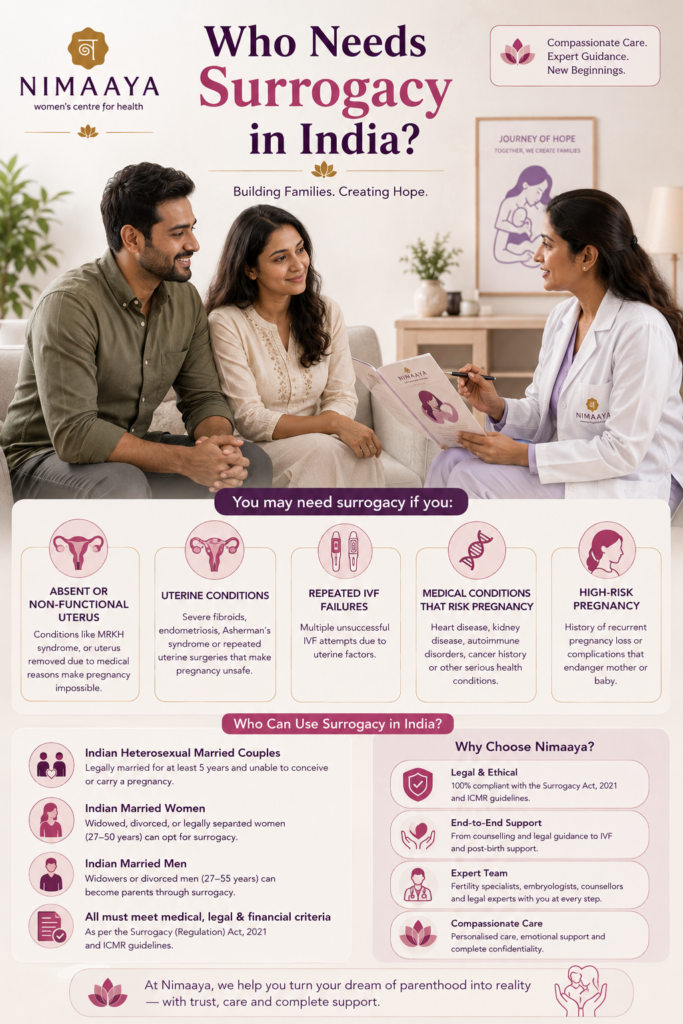
Surrogacy is considered when pregnancy is medically impossible, repeatedly unsuccessful, or potentially life-threatening.
The Surrogacy (Regulation) Rules, 2022, Rule 14 identifies medical indications for gestational surrogacy. These include:
1. Absence or significant abnormality of the uterus
Surrogacy may be considered when a woman:
- Has no uterus
- Has a missing uterus
- Has an abnormal uterus that cannot support pregnancy
- Has conditions such as a hypoplastic uterus, intrauterine adhesions, thin endometrium, small unicornuate uterus or T-shaped uterus
- Has undergone surgical removal of the uterus, such as following certain gynaecological cancers
2. Repeated implantation failure
Surrogacy may be considered where an intended parent or woman has repeatedly failed to conceive after multiple IVF or ICSI attempts, as defined under the applicable medical criteria.
This does not mean that every failed IVF cycle automatically qualifies someone for surrogacy. The medical indication must be assessed and certified through the prescribed process.
3. Recurrent pregnancy losses
Multiple pregnancy losses due to an unexplained medical reason may be considered within the prescribed criteria.
4. Medically unsafe pregnancy
Surrogacy may be considered where an illness makes it impossible for a woman to carry a pregnancy to viability or where pregnancy itself may be life-threatening.
Important: infertility alone does not automatically qualify someone
Surrogacy is not simply an alternative to IVF.
A fertility specialist first evaluates whether other evidence-based treatments can safely help achieve pregnancy. If there is a qualifying medical indication for gestational surrogacy, the case must then go through the required medical and regulatory certification process.
Medical Conditions That May Require Surrogacy
| Medical situation | Can pregnancy be carried? | May surrogacy be considered? |
|---|---|---|
| Absent uterus / congenital absence of uterus | No | Yes, if statutory criteria are met |
| Hysterectomy | No | Yes |
| Severe uterine abnormality | May be impossible or unsafe | Yes, depending on medical assessment |
| Certain severe endometrial/uterine conditions | May prevent implantation or pregnancy viability | Potentially |
| Recurrent implantation failure after multiple IVF/ICSI attempts | Repeatedly unsuccessful | Potentially |
| Recurrent unexplained pregnancy losses | May make carrying pregnancy unsuccessful | Potentially |
| Life-threatening pregnancy condition | Pregnancy may pose serious risk | Potentially |
| Medical illness preventing pregnancy from reaching viability | Pregnancy may be medically impossible | Potentially |
| One unsuccessful IVF cycle | Usually insufficient by itself | Not automatically |
| Age-related infertility alone | Pregnancy may still be possible | Not automatically |
* The District Medical Board determines whether the medical indication meets the applicable requirements.
How Does Surrogacy Work in India?
Surrogacy involves more than IVF and embryo transfer. It is a coordinated medical, psychological and regulatory process.
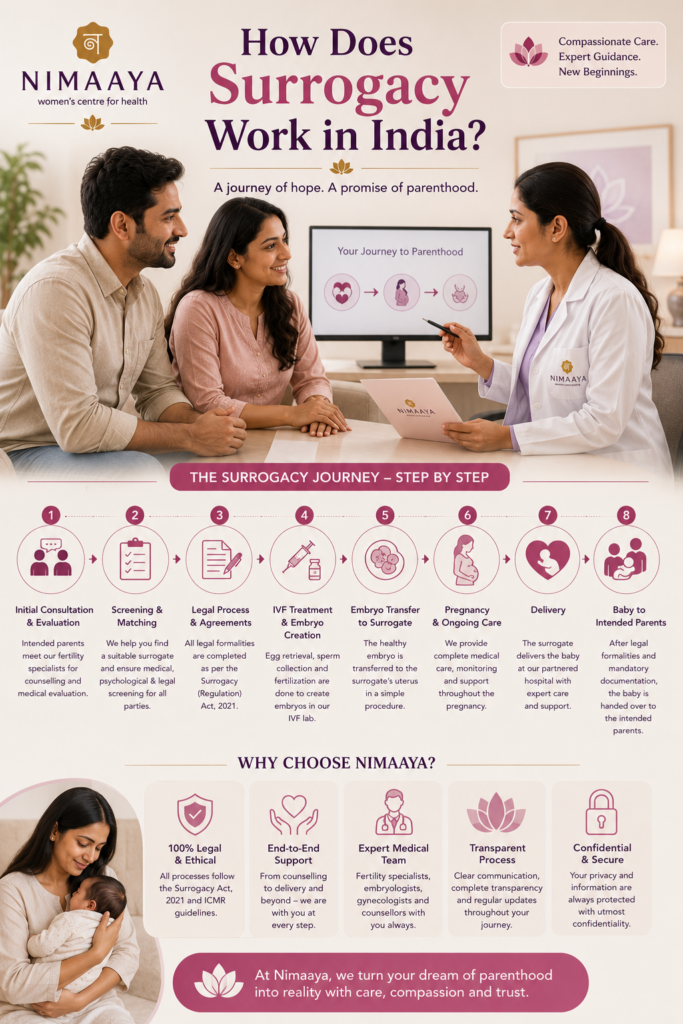
Step 1: Fertility and medical assessment
The journey begins with a detailed evaluation of the intended parent(s), including medical history, fertility assessment, previous IVF outcomes, reproductive history and the reason pregnancy cannot safely be carried.
The objective is to determine whether surrogacy is medically appropriate.
Step 2: Assessment of the medical indication
The applicant approaches the relevant District Medical Board, which evaluates the medical indication requiring gestational surrogacy.
A certificate confirming the medical indication is an important part of the legal process.
Step 3: Eligibility and essentiality certification
The intending parent(s) and surrogate must satisfy the prescribed eligibility requirements.
The State/UT Appropriate Authority issues the relevant certificates of essentiality and eligibility after the prescribed requirements are met.
Step 4: Surrogate screening
The willing surrogate undergoes:
- Medical assessment
- Psychological evaluation
- Eligibility verification
- Relevant laboratory investigations
- Pregnancy-risk assessment
The purpose is to protect both the surrogate and the future child.
Step 5: IVF and embryo creation
Depending on the medical plan, eggs and sperm are used to create embryos through IVF/ICSI.
Where the District Medical Board certifies a medical condition necessitating donor gametes, the current rules allow the use of a donor gamete provided the child has at least one gamete from the intending couple.
For an intending woman who is a widow or divorcee, the Government FAQ specifies self-eggs and donor sperm.
Step 6: Embryo transfer
A suitable embryo is transferred into the surrogate’s uterus after preparation of the uterine lining.
Under the current Government FAQ, normally one embryo is transferred in a treatment cycle, with up to three permitted in special circumstances.
Step 7: Pregnancy monitoring
Once pregnancy is established, the surrogate receives regular antenatal care, including appropriate scans, investigations and obstetric monitoring.
The pregnancy is managed with attention to both maternal and fetal wellbeing.
Step 8: Delivery and legal parentage
The legal process concerning parentage and custody is completed according to the applicable requirements.
The law provides that a child born through surrogacy is deemed to be the biological child of the intending couple or intending woman and receives the rights and privileges available to a natural child under applicable law.
What Documents and Approvals Are Required for Surrogacy?
The exact documentation depends on the applicant and case, but the process can involve:

- Medical reports establishing the qualifying condition
- District Medical Board certification
- Certificate of Essentiality
- Eligibility certificates
- Surrogate’s medical and psychological fitness certification
- Written informed consent from the surrogate
- Surrogacy agreement and related documentation
- Required insurance documentation
- Parentage/custody order
- Identity, marital status and citizenship documentation
- National Board recommendation where applicable for a couple of Indian-origin or intending women
Because documentation requirements can change and individual circumstances differ, Nimaaya recommends confirming the current requirements with the treating team and appropriate legal/regulatory authority before beginning treatment.
What Is the Cost of Surrogacy in India?
There is no single government-fixed price for surrogacy in India.
The total cost of surrogacy depends on the medical plan, IVF requirements, number of treatment cycles, embryo creation, medications, investigations, surrogate medical care, delivery, insurance, documentation, and whether additional medical treatment is required.
For planning purposes, Nimaaya currently uses an indicative range of approximately ₹15 lakh–₹30 lakh, but the final cost is individualised and should be confirmed through an itemised treatment estimate.
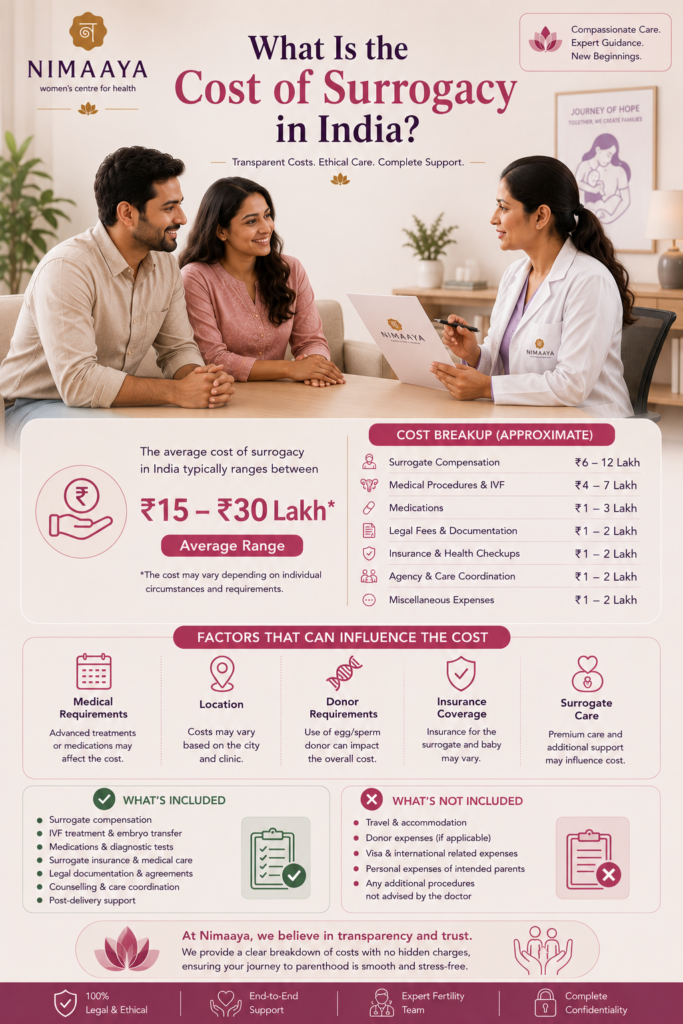
Typical cost components may include:
| Component | What it may include |
| Fertility evaluation | Consultations, scans and laboratory investigations |
| IVF/ICSI | Ovarian stimulation, egg retrieval, fertilisation and embryo culture |
| Medicines | Fertility and hormonal medications |
| Embryo transfer | Preparation and transfer-related treatment |
| Surrogate medical care | Screening, antenatal care and obstetric management |
| Delivery | Hospital and maternity-related expenses |
| Insurance | Required insurance coverage for the surrogate |
| Legal/regulatory documentation | Certificates, agreements and parentage-related documentation |
| Additional IVF cycles | If another embryo-transfer cycle is medically required |
Is the surrogate paid for surrogacy in India?
No commercial surrogate fee is permitted. The legal framework allows prescribed medical and related expenses and insurance coverage, but commercial payment for surrogate motherhood is prohibited.
Does Nimaaya offer a fixed surrogacy package?
Surrogacy should not be treated as a one-size-fits-all package. The appropriate approach is to evaluate the intended parents, establish eligibility, understand the medical plan, and then provide an itemised cost estimate based on the individual case.
How Long Does Surrogacy Take in India?
A surrogacy journey does not have a guaranteed fixed timeline. The overall duration depends on:
- Medical-board scheduling
- Eligibility and regulatory approvals
- Surrogate screening
- IVF and embryo creation
- Embryo availability
- Number of transfer attempts required
- Pregnancy and delivery
- Post-delivery documentation
The pregnancy itself is approximately nine months once a successful pregnancy is established, but the complete journey begins well before embryo transfer.
A realistic timeline should therefore be discussed after the initial medical and regulatory assessment rather than promised as a fixed number of months.
Gestational vs Traditional Surrogacy
| Feature | Gestational surrogacy | Traditional surrogacy |
| Surrogate’s egg used? | No | Yes |
| Surrogate genetically related to child? | No | Yes |
| IVF involved? | Yes | Not necessarily |
| Legal status in India | Recognised form | Not the recognised legal pathway |
| Surrogate provides genetic material? | No | Yes |
*Nimaaya follows the legally recognised gestational-surrogacy framework.
Can Donor Eggs or Sperm Be Used in Surrogacy in India?
This is an area where outdated information can be misleading.
Under the current rules, the general position is that an intending couple uses their own gametes. However, the 2024 amendment created an exception where the District Medical Board certifies that either the husband or wife has a medical condition requiring a donor gamete.
In such a case:
- A donor gamete may be used.
- At least one gamete must come from the intending couple.
- A widow or divorcee undergoing surrogacy must use her own eggs and donor sperm.
This should always be evaluated on an individual medical and regulatory basis.
Is Surrogacy Safe?
Surrogacy involves the medical risks associated with IVF, embryo transfer and pregnancy.
For the surrogate, pregnancy can involve potential complications such as:
- Gestational diabetes
- Hypertension and pre-eclampsia
- Anaemia
- Pregnancy-related complications
- Preterm birth
- Caesarean delivery
- Postpartum complications
The risk profile depends on the surrogate’s age, medical history, obstetric history and pregnancy characteristics.
This is why proper surrogate screening, psychological assessment, obstetric supervision, emergency preparedness and appropriate insurance are important components of a responsible surrogacy programme.
*No fertility centre can guarantee a successful pregnancy or live birth.
What Medical and Emotional Support Does a Surrogate Need?
Surrogacy should never be viewed only as an embryo-transfer procedure. The surrogate is undertaking a pregnancy that involves physical, emotional and social considerations.
A responsible programme should provide:
- Thorough medical screening
- Psychological assessment
- Informed consent
- Clear explanation of risks
- Appropriate antenatal monitoring
- Access to obstetric care
- Insurance coverage as required
- Respect for the surrogate’s autonomy
- Counselling and emotional support
- Clear communication with intended parents
*The law requires written informed consent and permits the surrogate to withdraw consent before embryo implantation.
What Happens If the Surrogate Has a Miscarriage or the Embryo Does Not Implant?
There is no guaranteed pregnancy outcome with IVF or surrogacy. An embryo may fail to implant, or a pregnancy may end in miscarriage despite appropriate medical care.
If this happens, the fertility team reviews:
- Embryo availability
- Previous transfer outcomes
- Uterine preparation
- Medical factors
- Whether another transfer is medically appropriate
If suitable embryos remain, another transfer may be considered according to the clinical plan and applicable regulations. A clinic should explain the possible outcomes and costs before treatment begins rather than promising a guaranteed result.
What Happens After the Baby Is Born?
The legal framework provides for the child born through surrogacy to be treated as the biological child of the intending couple or intending woman, with the rights and privileges applicable under law.
The parentage and custody documentation required under the Surrogacy Act involves a court order, and the Government FAQ explains that the order concerning parentage and custody is passed by a magistrate of the first class or above on the prescribed application.
The intended parents should therefore complete the legal documentation with appropriate professional guidance rather than assuming that the medical process alone establishes all required documentation.
Can a Surrogate Claim Parental Rights?
Under the Surrogacy Act framework, the surrogate mother relinquishes parental rights over the child born through the surrogacy arrangement. The Government FAQ specifically states that the surrogate mother does not claim parental rights over the child.
Can Intended Parents Abandon a Baby Born Through Surrogacy?
No. The Surrogacy (Regulation) Act prohibits intended parents from abandoning a child born through surrogacy, including because of genetic defects, birth defects, medical conditions, sex of the child or conditions that develop subsequently. If any couple engages in a certain kind of behavior, a punishable act is being used against them.
This provision is an important part of protecting children born through assisted reproduction.
Why Choose Nimaaya for Surrogacy in India?
Surrogacy requires more than an IVF laboratory. It requires medical expertise, regulatory awareness, careful screening, and coordinated care.
Specialist-led fertility care
Nimaaya’s surrogacy care is supported by experienced fertility and reproductive-health specialists, including Dr Yuvrajsingh Jadeja and Dr Pooja Nadkarni Singh.
Integrated fertility and IVF support
From fertility evaluation and IVF/ICSI to embryo transfer and pregnancy monitoring, the medical journey can be coordinated through Nimaaya’s fertility-care ecosystem.
Evidence-based decision-making
Surrogacy is considered only after evaluating the underlying medical reason and whether the patient meets the applicable legal and medical criteria.
Transparent treatment planning
Instead of promoting an unrealistic fixed “surrogacy package”, Nimaaya focuses on explaining the medical plan, expected treatment components and individualised cost considerations.
Counselling and patient support
Surrogacy can be emotionally complex for intended parents and the surrogate. Clear communication and appropriate counselling are important throughout the process.
Regulatory awareness
Because surrogacy in India is governed by detailed legislation and regulatory procedures, patients need a clinic that understands the importance of medical certification, eligibility, documentation and registered clinical practice.
Registered surrogacy facility
Why Medical and Legal Guidance Matter in Surrogacy
Choosing a surrogacy clinic should not be based only on:
- A claimed success rate
- A low advertised price
- A promised timeline
- A “guaranteed baby” package
- Availability of a surrogate
- Online reviews alone
Instead, intended parents should ask:
- Is the clinic properly registered?
- Who is the fertility specialist responsible for the case?
- Does the medical team explain whether I actually meet the medical indication?
- Who coordinates the District Medical Board process?
- What certificates and approvals are required?
- How is the surrogate screened?
- What medical and psychological support is provided?
- What exactly is included in the cost?
- What happens if an embryo transfer fails?
- What happens if pregnancy complications occur?
- How is the legal parentage process handled?
- Is the clinic transparent about the current law?
How to Choose the Right Surrogacy Centre in India
A good surrogacy centre should demonstrate clinical competence, regulatory compliance and ethical patient care.
Before choosing a centre, check:
1. Registration
Confirm that the clinic is registered under the applicable ART and Surrogacy regulatory framework. The National ART & Surrogacy Registry provides a public record of registered clinics.
2. Specialist expertise
Understand who will manage your fertility treatment, IVF cycle and pregnancy-related care.
3. Embryology capabilities
Ask about laboratory standards, embryo culture, cryopreservation and quality-control practices.
4. Transparent costs
Request an itemised estimate rather than relying on a headline package price.
5. Regulatory support
The clinic should clearly explain the required certifications and approvals.
6. Surrogate welfare
The surrogate’s health, informed consent, psychological wellbeing and insurance should be treated as essential—not secondary.
7. Honest communication
Avoid any centre promising a guaranteed pregnancy, guaranteed live birth or guaranteed baby.
Read more about: How to Choose the Right IVF & Fertility Clinic for Safe & Successful Infertility Treatment
Surrogacy in India: A Simple Eligibility Checklist
You may be able to explore surrogacy if:
- You have a qualifying medical indication.
- Your medical indication can be evaluated by the District Medical Board.
- You satisfy the applicable age and marital-status requirements.
- You meet the statutory eligibility conditions.
- The proposed surrogate satisfies the eligibility criteria.
- The required certificates and approvals can be obtained.
- Required insurance is arranged.
- Treatment is performed through a registered surrogacy clinic.
* Meeting one or more of these conditions does not itself guarantee legal eligibility. Your complete case must be assessed under the current law and rules.
Frequently Asked Questions About Surrogacy in India
Is surrogacy legal in India?
Yes. Surrogacy is legal in India under a tightly regulated framework, but only eligible applicants can access it and commercial surrogacy is prohibited.
What is the current surrogacy law in India?
The principal law is the Surrogacy (Regulation) Act, 2021, supported by the Surrogacy Rules, 2022 and subsequent amendments and regulations. The Act came into force on 25 January 2022.
Is commercial surrogacy allowed in India?
No. Only altruistic surrogacy is permitted under the current framework.
Who is eligible for surrogacy in India?
Eligibility depends on the applicant’s medical indication, age, marital/citizenship status and other statutory requirements. Legally married Indian couples and eligible intending women who are widowed or divorced may qualify, while specific rules apply to couples of Indian origin/OCI applicants.
Can a single woman have surrogacy in India?
An unmarried single woman cannot avail surrogacy. An Indian woman who is a widow or divorcee aged 35–45 may qualify as an intending woman subject to the applicable requirements.
Can a single man have surrogacy in India?
No. The current government FAQ states that a single man cannot avail himself of surrogacy in India.
Can foreigners have surrogacy in India?
No. Foreigners cannot currently avail surrogacy services in India. Specific rules apply to eligible NRIs, OCIs and couples of Indian origin.
Does a surrogate have to be a close relative?
No. The Government’s current FAQ explicitly states that the surrogate does not have to be a close relative of the intending couple.
What is the age limit for a surrogate mother in India?
A surrogate must be an ever-married woman aged 25–35 years and must have a child of her own, subject to the other eligibility requirements.
Can the surrogate use her own egg?
No. A surrogate cannot provide her own gamete.
Is the surrogate genetically related to the baby?
No. In gestational surrogacy, the surrogate does not provide the egg and therefore is not genetically related to the child.
Can donor eggs or sperm be used?
In specified circumstances, yes. If the District Medical Board certifies that one member of the intending couple has a medical condition requiring a donor gamete, donor gamete use may be permitted, provided at least one gamete comes from the intending couple. A widow or divorcee undergoing surrogacy must use her own eggs and donor sperm.
What medical conditions qualify for surrogacy?
The Rules identify conditions including absence or significant abnormality of the uterus, hysterectomy, recurrent implantation failure after multiple IVF/ICSI attempts, multiple unexplained pregnancy losses and illnesses that make carrying a pregnancy to viability impossible or life-threatening.
Can surrogacy be used without a medical indication?
No. The Government FAQ states that surrogacy cannot be availed without a qualifying medical condition certified through the prescribed process.
How much does surrogacy cost in India?
There is no single fixed price. At Nimaaya, an indicative planning range is approximately ₹15 lakh–₹30 lakh, depending on the individual medical plan, IVF requirements, surrogate care, insurance, delivery and documentation. A personalised estimate should be obtained before treatment.
Does the surrogate receive money?
Commercial compensation is prohibited. Permitted medical and prescribed expenses and insurance coverage can be provided according to the applicable framework.
How long does surrogacy take in India?
The complete journey varies because it includes medical assessment, regulatory approvals, surrogate screening, IVF, embryo transfer, pregnancy and post-delivery documentation. The pregnancy itself is approximately nine months after conception.
How many embryos can be transferred to a surrogate?
The Government FAQ states that normally one embryo is transferred during a treatment cycle, while up to three may be transferred in special circumstances.
How many times can a surrogate undergo surrogacy?
A woman cannot act as a surrogate more than once in her lifetime. The Government FAQ states that the number of surrogacy procedure attempts on her cannot exceed three.
What insurance is required for the surrogate?
The intending couple or intending woman must arrange the prescribed insurance coverage for the surrogate for 36 months, including coverage relating to postpartum delivery complications.
What happens if the surrogate changes her mind?
The law provides that a surrogate can withdraw her consent before implantation of the embryo. Written informed consent is mandatory.
Can intended parents abandon a child born through surrogacy?
No. Abandonment of a child born through surrogacy is prohibited under the Act.
Does the baby need to be adopted by the intended parents?
Surrogacy and adoption are legally different processes. The Surrogacy Act provides that the child born through surrogacy is deemed to be the biological child of the intending couple or intending woman, subject to the statutory framework and required documentation.
Is surrogacy the same as IVF?
No. IVF is a fertility treatment in which eggs and sperm are combined outside the body to create embryos. Surrogacy involves transferring an embryo to another woman—the surrogate—who carries the pregnancy. IVF may therefore be one part of a surrogacy journey.
Is surrogacy guaranteed to work?
No. Neither IVF nor surrogacy can guarantee pregnancy or live birth. Outcomes depend on factors including embryo quality, age, reproductive history, uterine environment, medical conditions and other individual factors.
A Responsible Approach to Surrogacy in India
Surrogacy can offer a pathway to parenthood for people who cannot safely carry a pregnancy, but it should never be approached as a commercial transaction or a guaranteed fertility treatment.
The most important first step is not finding a surrogate or comparing prices.
It is determining: Do I have a medical indication for surrogacy, and am I legally eligible to pursue it in India?
Once that is established, the fertility team can help you understand IVF options, embryo creation, surrogate screening, medical monitoring, regulatory approvals, expected costs and the next steps.
At Nimaaya, our approach is centred on specialist-led fertility care, ethical practice, clear communication and personalised treatment planning.
Begin Your Surrogacy Journey With Nimaaya
If pregnancy is medically impossible, repeatedly unsuccessful or unsafe for you, our fertility specialists can assess whether surrogacy may be an appropriate option.
Nimaaya Women’s Centre for Health provides fertility and reproductive care across Surat, Vadodara and Ahmedabad, with a focus on personalised assessment and coordinated IVF care.
Your first consultation can help answer:
- Do I medically qualify for surrogacy?
- What documents and approvals will I need?
- Does my case require a District Medical Board assessment?
- What IVF or embryo-creation approach may be appropriate?
- What are the expected costs?
- What should I know about the surrogate’s medical care?
- What are the current legal requirements?
Book a consultation with the Nimaaya fertility team to understand your options.
Medical Disclaimer
This page provides general educational information about surrogacy in India and is not a substitute for individual medical or legal advice. Eligibility, medical indications, documentation and regulatory requirements must be assessed for each case. Indian surrogacy regulations may be amended or supplemented by government notifications, rules, regulations and directions. Always confirm the current requirements with a registered fertility/surrogacy clinic and the relevant Appropriate Authority before beginning treatment.
* Information reviewed against Government of India sources available as of August 2026.