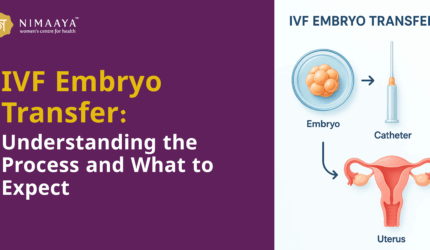
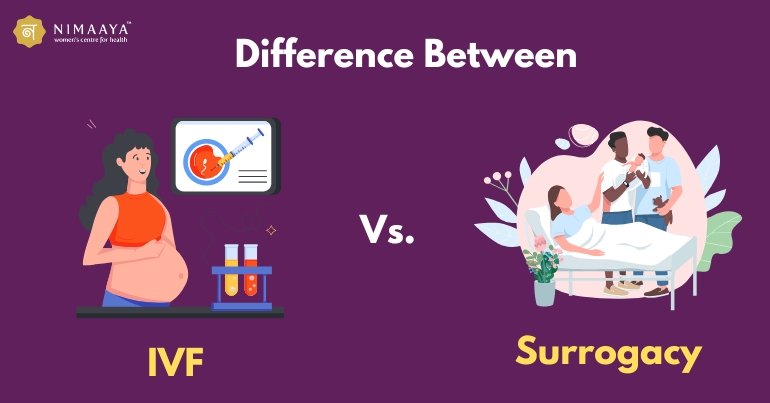
Assisted reproductive technology options that have become most common among the options availed to many single and married couples are In Vitro Fertilization (IVF) and surrogacy. Both options provide intenders possibilities for conceiving, yet they are fundamentally different in how they operate their purposes, and their legal status. In this way, one can draw comparisons between IVF vs surrogacy in terms of procedures, requirements, ethics, and outcomes.
What is IVF?
Definition and Overview
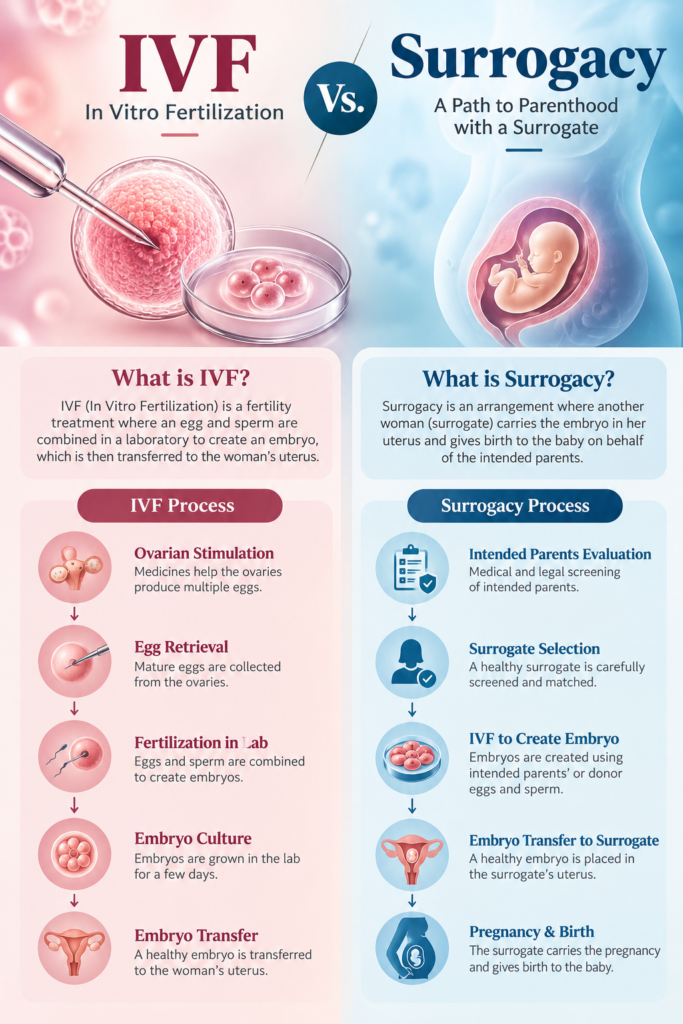
In vitro fertilization (IVF) is the procedure in which an egg is fertilized with sperm outside the body using a controlled laboratory environment. The embryo(s) resulting from this process are then transferred back into the uterus for implantation and possible subsequent pregnancy.
What is IVF Process
- Ovarian Stimulation: Hormonal injections are given to the woman to stimulate the ovaries so that they can produce more than one egg.
- Egg Retrieval: Under a procedure called transvaginal ultrasound aspiration, mature eggs are harvested from the ovary.
- Fertilization: The harvested eggs are then fertilized in a laboratory with the partner or donor’s sperm. Conventional fertilization or Intracytoplasmic Sperm Injection (ICSI) could be used.
- Embryo Culture: The fertilized ovum develops into an embryo for a few days in the incubator.
- Embryo Transfer: A healthy embryo or embryos are transferred into the uterus.
- Pregnancy Test: After two weeks, a blood test is done to determine if the procedure was successful.
Advantages of IVF
- Therefore it provides hopeful promises to a variety of fertility-related problems such as blocked fallopian tubes, insufficiency in sperm count, or even increasing maternal age.
- Can be performed in conjunction with various other procedures, such as genetic testing or egg freezing.
- Provides an opt-in plan for biological fatherhood.
Challenges of IVF
Drag of emotions: The process continues to inflict tremendous stress both physically and emotionally.
Numerous medical risks: Ovarian hyperstimulation syndrome (OHSS) and multiple pregnancies.
What is Surrogacy?
Definition and Overview
Surrogacy is a form of assisted reproduction whereby a woman (the surrogate) carries and delivers a child for an individual or couple (intended parents). Usually, this is allowed when the intended mother does not have a healthy reason for being able to carry a pregnancy or even has an absence of a uterus.
Types of Surrogacy
Traditional surrogacy: The surrogate will use her egg, thus making her the biological mother of any resulting child. This is not a common method due to its legal and ethical complications.
Gestational surrogacy: An embryo made through IVF from the sperm and egg of the intended parents or donors is implanted in the uterus of the surrogate. The surrogate is not genetically related to the child at all.
what is surrogacy process?
Screening and matching: Before matching the surrogate with the intended parents, the surrogate will undergo medical and psychological evaluation.
Legal arrangement: There is a surrogacy agreement that outlines the rights and responsibilities of all the parties involved.
IVF procedure: In this case, embryos will be transferred to the uterus of a surrogate mother after creating them through the IVF process.
Advantages of Surrogacy
- There are solutions for people who cannot successfully carry a pregnancy, including same-sex males and women with uterine abnormalities.
- It will allow for possible biological connection to the baby from one or both expected parents (in gestational surrogacy).
- Advanced IVF techniques have a high chance.
Challenges of Surrogacy
- High cost, including medical, legal, and surrogate compensation fees.
- Legal and ethical complexities, especially in countries where surrogacy laws are restrictive.
- Emotional implications for all parties involved.
Key Difference between IVF and Surrogacy
|
Aspect |
IVF |
Surrogacy |
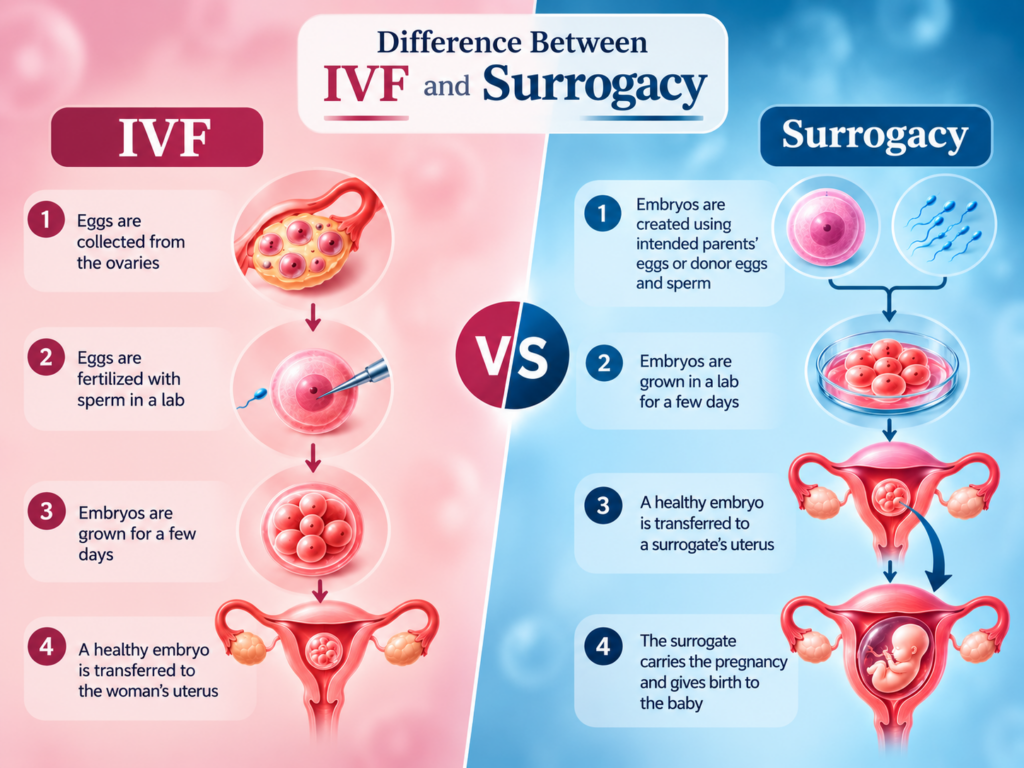
| Definition | A woman’s inherent uterus is used for fertility treatment to get conceived. | Another woman voluntarily carries the pregnancy. |
| Purpose | It is provided to overcome natural fertility barriers for those who want to conceive. | To people who cannot carry a pregnancy. |
| Participants | The intended mother intended father (or sperm donor), and medical team. | The surrogate intended parents, and medical team. |
| Procedure | Eggs and sperm are fertilized in a lab, and the embryo is transferred to the intended mother | The surrogate’s uterus carries the pregnancy after embryo transfer. |
| Genetic Connection | A child is biologically related to one or both parents (unless donor gametes are used). | In gestational surrogacy, the child is genetically related to the intended parents (if their gametes are used). |
| Legal Complexity | It is relatively straightforward, with minimal legal requirements. | Highly regulated, with demand for comprehensive contracts and legal compliance. |
| Emotional Involvement | Limited to the intended parents’ fertility journey. | This is where it becomes emotional for both the surrogate and intended parents. |
| Cost | Very high but generally less than surrogacy. | It is the costliest because of the surrogate compensation and legal fees. |
Ethical Considerations
IVF
- Unused Embryos: These raise ethical questions regarding their destination.
- Accessibility: Price makes it unavailable to the majority.
- Multiple Pregnancies: Generally twins or triplets are conceived which increases liabilities to mothers and their babies.
Surrogacy
- Exploitation Risks: Surrogates especially in low-income regions risk exploitation.
- Parental Rights: Legal rights on parenthood can cause disputes.
- Emotional Attachments: Emotional attachments could develop in cases of surrogacy hindering the process of handover.
When to Choose IVF or Surrogacy
IVF is suitable for:
- Blocked fallopian tubes or hormonal imbalances are instigating the lack of ovulation in women.
- Infertility of unknown cause in the couple.
- Want biological connection with kids.
Surrogacy is suitable for:
- Women who cannot conceive due to medical conditions.
- Males of the same sex pairs or single men wishing to have biological children.
- Pairs with consistent failures in IVF treatments.
Global Legal Landscape
IVF Laws
On the whole, most opposing nations’ IVF laws are acknowledged and implemented. As far as legal issues are concerned, they are commonly associated with embryo preservation and donor gametes.
Surrogacy Laws
- Surrogacy laws are variable globally:
- Permissive countries: The U.S. (certain states), Georgia, Ukraine, and Russia.
- Restricting country: A considerable part of European and Asian countries belongs to those who deny or heavily put in place regulations on surrogacy.
Success Rates
IVF
Success depends on:
- Maternal age has higher success among younger women.
- Quality of eggs and sperm.
- Number of attempts at IVF cycles.
Surrogacy
- Involvement of healthy medical-checked surrogates results in higher success chances.
- IVA procedures also play a role in success.
Read More: सरोगेसी का हिंदी में मतलब (Surrogacy meaning in Hindi): एक नयी जीवन की शुरुआत
Conclusion
For individuals and couples wishing to find pathways through infertility, IVF and surrogacy serve as significant strategies to achieve their goals. IVF offers something specific to those who can bear a child but require the assistance of someone medically competent to conceive. On the other hand, surrogacy is a way of providing hope and joy to those who cannot bear a child for themselves as it is opened through the act of a surrogate mother.
Before taking the plunge into the treatment, aspiring parents should have a consultation with the accredited center. Nimaaya IVF Center has gained massive recognition when it comes to offering the best in reproductive medicine. The clinic has been instrumental in making dreams come true with fantastic advanced technology and friendly staff like Dr Yuvrajsingh jadeja and Dr Pooja nadkarni dedicated to making you know you are not alone in your parenthood path whether through IVF or surrogacy options.
Frequently Asked Questions About IVF and Surrogacy
1. Is IVF the same as surrogacy?
No. IVF and surrogacy are different medical and reproductive processes. IVF is a fertility treatment in which eggs and sperm are combined in a laboratory to create embryos. The resulting embryo may then be transferred to the woman’s own uterus or, when legally and medically appropriate, to a gestational surrogate.
Surrogacy refers to another woman carrying the pregnancy for the intended parent or parents. In gestational surrogacy, the surrogate carries an embryo but does not provide the egg. Therefore, IVF is often the medical procedure used to create the embryo, while surrogacy determines who carries the pregnancy.
2. Can IVF be used for surrogacy?
Yes. Gestational surrogacy generally involves IVF to create an embryo before it is transferred to the surrogate’s uterus. Depending on the medical circumstances and applicable Indian regulations, the embryo may be created using the intended mother’s egg, or a permitted donor egg, together with sperm from the intended father or an appropriate donor.
The surrogate’s role is to carry the pregnancy; she does not provide the egg in gestational surrogacy.
3. Whose egg is used in surrogacy?
In gestational surrogacy, the egg may come from the intended mother or an egg donor, depending on the medical circumstances and legal requirements. The egg is fertilised through IVF and the resulting embryo is transferred to the surrogate.
In India, the rules governing donor gametes have specific conditions. Following the 2024 amendment, donor gametes may be used when the District Medical Board certifies that a medical condition necessitates their use, provided that the child has at least one gamete from the intending couple.
4. Is a surrogate baby biologically related to the intended parents?
It can be. In gestational surrogacy, the surrogate herself has no genetic relationship with the baby because she carries an embryo created before implantation.
When the intended mother’s egg and intended father’s sperm are used, the child is genetically related to both intended parents. If a permitted donor egg or donor sperm is used, the genetic relationship depends on which gamete comes from the donor.
Indian law also provides that a child born through a surrogacy procedure is treated as the biological child of the intending couple or intending woman for the purposes specified under the Act.
5. Which is more expensive: IVF or surrogacy?
Surrogacy generally involves more costs than IVF alone because it can include IVF and embryo-related treatment in addition to the medical care associated with another woman carrying the pregnancy.
The overall expense can vary considerably depending on the number of IVF cycles, medications, embryo procedures, required investigations, pregnancy and delivery care, insurance and legally permitted expenses.
In India, commercial payment or remuneration to a surrogate is prohibited; the legal framework permits altruistic surrogacy and provides for specified medical and insurance-related expenses.
6. Who may need surrogacy instead of IVF?
Surrogacy may be considered when a woman cannot safely carry a pregnancy or cannot carry one to viability because of a medical condition. Under India’s Surrogacy (Regulation) Rules, medical indications include absence or significant abnormality of the uterus, surgical removal of the uterus, certain repeated implantation failures, recurrent pregnancy losses from unexplained medical causes, or an illness that makes pregnancy impossible or life-threatening.
Surrogacy is therefore not simply an alternative to IVF for anyone experiencing infertility. In India, a qualifying medical indication must be established through the prescribed regulatory process.
7. Is surrogacy legal in India?
Yes. Surrogacy is legally regulated in India under the Surrogacy (Regulation) Act, 2021 and associated rules and regulations. The law permits gestational surrogacy under specified medical and eligibility conditions and prohibits commercial surrogacy.
The Act came into force on 25 January 2022. Surrogacy must be undertaken through the prescribed regulatory framework, including the required medical certification and approvals.
8. What are the eligibility requirements for surrogacy in India?
Eligibility depends on the category of intended parent and the applicable statutory requirements. For an intending couple, the law requires a medical indication necessitating gestational surrogacy, along with the prescribed certificates and approvals. The couple must meet the applicable age, marital and other eligibility conditions under the Act and Rules.
A willing surrogate must also satisfy prescribed requirements, including being an ever-married woman who has a child of her own, being 25–35 years old, and meeting the required medical and psychological fitness criteria. She cannot provide her own gametes for the surrogacy.
Because eligibility rules can be amended and individual circumstances matter, the clinic should verify the current requirements before beginning the process.
9. Can a surrogate use another woman’s egg?
Yes, but the wording needs an important clarification: the surrogate does not carry another woman’s unfertilised egg. In gestational surrogacy, an embryo is created through IVF using an egg from the intended mother or, where legally permitted, an egg donor. That embryo is then transferred to the surrogate’s uterus.
Under India’s 2024 amendment, donor gametes can be used in specified medical circumstances certified by the District Medical Board, provided that at least one gamete comes from the intending couple.
10. Is surrogacy always successful?
No. Surrogacy does not guarantee a pregnancy or live birth. The outcome depends on several factors, including embryo quality, the age and reproductive health of the person providing the egg, sperm factors, uterine conditions, embryo-transfer factors and the health of the gestational surrogate.
It is also important to distinguish embryo-transfer success, clinical pregnancy and live-birth rates, because these are different outcomes. A clinic’s reported success rate should therefore be understood in the context of the patient’s age, embryo characteristics, treatment type and the specific outcome being measured.
11. Is IVF the same as surrogacy?
No. IVF and surrogacy are different medical and reproductive processes. IVF is a fertility treatment in which eggs and sperm are combined in a laboratory to create embryos. The resulting embryo may then be transferred to the woman’s own uterus or, when legally and medically appropriate, to a gestational surrogate.
Surrogacy refers to another woman carrying the pregnancy for the intended parent or parents. In gestational surrogacy, the surrogate carries an embryo but does not provide the egg. Therefore, IVF is often the medical procedure used to create the embryo, while surrogacy determines who carries the pregnancy.