The HSA test is one of the most confusing terms in fertility care because it means something different depending on who’s being tested. For men, HSA usually refers to Human Sperm Assay (a form of semen analysis) a test that checks sperm count, motility, and morphology. For women, HSA is often a shorthand misuse of HSG (Hysterosalpingography), an X-ray procedure that checks whether the fallopian tubes are open and the uterine cavity is normal. Both are common, safe, first-line tests used early in a fertility workup.
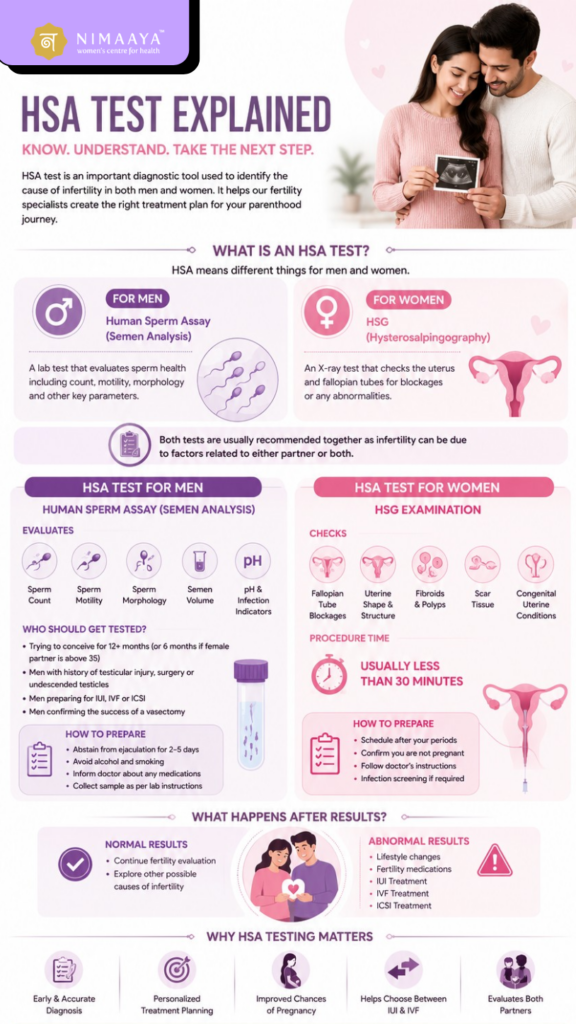
- HSA means different things for men and women — there is no single universal “HSA test”.
- For men, it generally points to semen analysis (human sperm assay), evaluating sperm count, motility, and morphology.
- For women, it’s typically a colloquial stand-in for HSG, which checks the uterus and fallopian tubes for blockages or structural issues.
- Both male and female versions are usually recommended together since infertility can stem from either partner or both.
If you and your partner have started fertility testing, there’s a good chance you’ve come across the term “HSA test” and felt a little lost. Search for it online and you’ll get different answers depending on whether the context is male or female fertility, which only adds to the confusion at a time when you’re already navigating a lot of new, unfamiliar information.
You’re not alone in this. Most couples trying to conceive don’t know which partner’s fertility issue is causing the delay, if there even is one. That’s exactly why early diagnostic testing matters; it replaces guesswork with clear answers, and clear answers make it possible to choose the right treatment path sooner rather than later.
“HSA Test” isn’t one single test. It’s an abbreviation that fertility clinics, lab reports, and patients use loosely to refer to different things depending on whether a man or a woman is being evaluated. Once you understand which one applies to your situation, the rest becomes much easier to follow.
In this guide, we’ll walk through what the HSA test means for men and for women, what the procedures involve, how to read your results, and what typically happens next. These are common, well-established, and low-risk tests – used in fertility clinics every day to help couples move toward a treatment plan with confidence.
What Is an HSA Test?
At its core, an HSA test is a diagnostic tool used during a fertility workup to identify whether a physical or biological factor is contributing to difficulty conceiving. Doctors recommend it because infertility can originate with either partner; male factors and female factors each account for a substantial share of cases, so a thorough evaluation typically includes testing both.
The confusion around the term comes from the fact that “HSA” is used as shorthand for two completely different procedures:
- In male fertility evaluation, HSA usually stands for Human Sperm Assay, a semen analysis that examines sperm health.
- In female fertility evaluation, HSA is often used informally to refer to HSG (Hysterosalpingography), an imaging test of the uterus and fallopian tubes.
Both play an important role before a couple moves forward with treatments like IUI (intrauterine insemination) or IVF (in vitro fertilisation), since the results directly shape which treatment approach is likely to work best.
HSA Test Full Form: Why Does It Mean Different Things for Men and Women?
This is the part that trips up most people, and understandably so. Patients often hear “HSA test” mentioned by a doctor or see it listed on a lab requisition form, then search online and find answers that don’t match what they expected. That’s because the term isn’t standardised the way something like “blood pressure test” is — it depends entirely on context.
HSA Test Full Form for Men
For male fertility evaluation, HSA most commonly stands for Human Sperm Assay, which is essentially another name for semen analysis. It evaluates how healthy and functional a man’s sperm are, looking at count, movement, and shape, to determine whether sperm-related factors could be affecting conception.
HSA Test Full Form for Women
For female fertility evaluation, HSA is frequently used as a casual (and technically imprecise) stand-in for HSG, or Hysterosalpingography — an X-ray-based procedure that assesses the uterus and fallopian tubes. The terms get conflated in everyday conversation, but they refer to the same underlying test.
Knowing which one applies to you depends on which partner is being tested and what your doctor has specifically recommended. If you’re ever unsure, it’s always reasonable to ask your clinic directly which test they mean by “HSA” in your case.
HSA Test for Male Fertility: Understanding Human Semen Analysis
What Is Human Semen Analysis?
Semen analysis is typically the first test ordered when evaluating male fertility. A semen sample is collected, usually through masturbation, into a sterile container at the clinic or at home with prompt delivery, and examined under a microscope to assess several measurable characteristics of the sperm and the fluid carrying them.
Why Is It Important for Fertility Assessment?
Male factors contribute to a significant proportion of infertility cases, either alone or alongside female factors. Semen analysis gives a direct, objective picture of sperm health, which makes it one of the most informative and cost-effective tests available early in a fertility workup.
Who Should Undergo an HSA Test?
Doctors generally recommend semen analysis for:
- Couples who haven’t conceived after 12 months of regular, unprotected intercourse (or 6 months if the female partner is over 35)
- Men with a known history of testicular injury, surgery, or undescended testicles
- Men preparing for IUI, IVF, or ICSI
- Men confirming the success of a vasectomy
Parameters Evaluated During Semen Analysis
A standard semen analysis report typically breaks results down into several key parameters:
Sperm Count
The total number of sperm present in the ejaculate, along with concentration (sperm per millilitre of semen).
Sperm Motility
How well the sperm move. Progressive motility — sperm swimming forward in a relatively straight line — matters most, since that’s what’s needed to reach and fertilize an egg.
Sperm Morphology
The shape and structure of individual sperm, assessed under high magnification. Even fertile men typically have a meaningful proportion of abnormally shaped sperm; the test looks at what percentage have a normal form.
Semen Volume
The total amount of fluid in the sample can affect how sperm are transported and how the concentration is calculated.
pH and Other Indicators
Additional markers, such as pH level, liquefaction time, and the presence of white blood cells, can point toward infection or other underlying issues.
What Do HSA Test Results Mean?
Lab reports compare your results against standard reference ranges (most current clinics use the World Health Organization’s most recent semen analysis manual). Results falling within the expected range are generally reassuring, while values below the reference threshold — whether in count, motility, or morphology — don’t necessarily mean conception is impossible, but they do help your specialist understand what’s contributing to delayed conception and which treatment approach is likely to be most effective.
It’s also worth knowing that sperm production is a roughly two- to three-month cycle, so a single abnormal result is often followed by a repeat test before any major conclusions are drawn.
HSA Test for Female Fertility: Understanding HSG Examination
What Is HSG (Hysterosalpingography)?
HSG is an X-ray procedure used to evaluate the inside of the uterus and, in some cases, to detect blocked fallopian tubes. A small amount of contrast dye is passed through the cervix, allowing the radiologist to see the shape of the uterine cavity and track whether the dye flows freely through both tubes.
Why Is HSG Recommended During Fertility Evaluation?
HSG remains one of the standard first-line tests for female infertility because it directly addresses two of the most common structural causes of difficulty conceiving: blocked or damaged fallopian tubes and abnormalities inside the uterus itself. It’s also relatively quick, doesn’t require general anaesthesia, and is widely available at diagnostic and fertility centres.
How Does the Procedure Work?
The test is usually scheduled in the first half of the menstrual cycle, typically a few days after your period ends and before ovulation, to avoid any chance of disrupting an early pregnancy. A speculum is placed, a thin catheter is inserted through the cervix, and contrast dye is slowly injected while X-ray images are taken in real time. The entire procedure usually takes well under thirty minutes.
What Conditions Can HSG Detect?
Blocked Fallopian Tubes
If the dye doesn’t flow through to the end of one or both tubes, it suggests a blockage — one of the more common causes of female infertility.
Uterine Abnormalities
Irregularities in the shape of the uterine cavity, such as fibroids or polyps pressing into the cavity, can show up clearly on the images.
Scar Tissue
Adhesions from prior infection, surgery, or procedures like a D&C can sometimes be identified through how the dye distributes.
Congenital Uterine Conditions
Structural variations present from birth, such as a septate or bicornuate uterus, can also be visible on HSG imaging.
What Do HSG Results Mean?
A normal HSG shows open fallopian tubes and a regularly shaped uterine cavity. If a blockage or structural issue is found, your fertility specialist will use that information to decide whether the next step is medical management, a surgical correction, or moving directly to IVF, which can bypass tubal issues altogether since fertilisation happens outside the body.
How to Prepare for an HSA Test
Preparation Tips for Men
- Maintain an abstinence period of typically 2 to 5 days before the sample is collected, as advised by your clinic
- Avoid alcohol in the days leading up to the test
- Avoid smoking, or at a minimum reduce it, since it can affect sperm quality
- Disclose any medications or supplements you’re taking, as some can influence results
Preparation Tips for Women
- HSG is typically scheduled at a specific point in the menstrual cycle, usually a few days after bleeding stops and before ovulation
- Your doctor may screen for active infections beforehand, since the procedure shouldn’t be done in the presence of one
- You’ll generally be asked to confirm you’re not currently pregnant before the test
- Follow any specific instructions your clinic provides regarding pain relief medication beforehand
Is the HSA Test Painful or Risky?
What Men Can Expect
Semen analysis involves no physical discomfort beyond the collection process itself. There’s no needle, no incision, and no recovery time required.
What Women Can Expect During HSG
Most women experience some cramping during and shortly after the procedure, similar to menstrual cramps, and it typically passes within a day. Many clinics recommend taking an over-the-counter pain reliever beforehand.
Possible Side Effects and Safety Considerations
- Mild to moderate cramping during the procedure
- Light spotting for a day or two afterwards
- Rare complications such as infection or an allergic reaction to the contrast dye, which clinics screen for in advance
Both tests are considered standard, low-risk procedures performed routinely as part of fertility evaluations worldwide.
Understanding Your HSA Test Results: What Happens Next?
When Results Are Normal
A normal result on either test is genuinely good news, but it isn’t the end of the investigation if a couple hasn’t conceived – it simply rules out one possible cause and directs attention toward other factors, such as ovulation, hormone levels, or unexplained infertility.
When Male Fertility Factors Are Found
If semen analysis reveals lower-than-expected count, motility, or morphology, your specialist will weigh the severity of the finding against treatment options ranging from lifestyle adjustments and medication to IUI, IVF, or ICSI for more significant cases.
When Female Fertility Factors Are Found
If HSG reveals blocked tubes or structural concerns, the path forward might involve surgical correction in some cases, or moving directly to IVF, which sidesteps the fallopian tubes entirely.
Additional Tests Your Doctor May Recommend
Depending on what the initial results show, your specialist may suggest additional testing to build a fuller picture, including:
- AMH (Anti-Müllerian Hormone) test, to assess ovarian reserve
- A broader hormonal profile
- Pelvic ultrasound
- Sperm DNA fragmentation testing
- Genetic testing, in select cases
HSA Test and IVF: Why Fertility Specialists Recommend It Before Treatment
Before recommending any fertility treatment, specialists need a clear picture of what’s actually causing the delay in conception, and both semen analysis and HSG are foundational pieces of that picture. Skipping them means starting treatment based on assumptions rather than evidence.
This matters for both IUI and IVF. For IUI to have a reasonable chance of success, sperm parameters need to meet certain thresholds, and the fallopian tubes need to be open. For IVF, sperm quality still informs decisions like whether standard insemination or ICSI is the better approach, even though the procedure itself bypasses the fallopian tubes.
In short, these tests aren’t a formality; they’re what allow a treatment plan to be built around your specific situation rather than a generic protocol, which directly improves the odds of success.
How Fertility Specialists Use HSA Test Results to Create Personalised Treatment Plans
Once both partners have completed their evaluations, your fertility specialist puts the full picture together to recommend a path forward. Depending on the findings, this might include:
- IUI, when sperm parameters are mildly reduced, and the fallopian tubes are open
- IVF, when tubal blockage is present, or when other factors make natural conception unlikely
- ICSI, an IVF variation used when sperm count or motility is significantly low
- Surgical correction for certain structural uterine or tubal issues identified on HSG
- Lifestyle interventions, such as changes to diet, weight, smoking, or alcohol use, are often recommended alongside medical treatment when semen parameters are borderline
The goal at every step is to match the treatment to the actual cause, not to default to the most aggressive option when a simpler one might work just as well.
Why Choose Nimaaya IVF Centre for Comprehensive Fertility Evaluation?
Navigating fertility testing can feel overwhelming, especially when the terminology itself is confusing. At Nimaaya IVF Centre, our fertility specialist, Dr Pooja Nadkarni Singh, guides you through every step of the diagnostic process, from semen analysis and HSG to advanced hormonal and genetic testing, with clarity and compassion.
Our approach combines advanced diagnostic capabilities with personalised treatment planning for both male and female fertility factors, so you’re never left guessing what your results mean or what comes next. Whether you’re just beginning your fertility journey or have already faced setbacks elsewhere, our team is here to provide answers and a clear path forward.
Frequently Asked Questions About the HSA Test
What is the HSA test used for?
It’s used to evaluate fertility for men; it typically refers to semen analysis; for women, it’s commonly used as shorthand for HSG, which checks the uterus and fallopian tubes.
What is HSA test full form in fertility treatment?
There isn’t one universal full form. For men, it generally means Human Sperm Assay; for women, it’s often used loosely to mean Hysterosalpingography (HSG).
What is HSA test for male fertility?
It refers to semen analysis, which evaluates sperm count, motility, morphology, volume, and other markers of sperm health.
What is HSA test for female fertility?
It typically refers to HSG, an X-ray procedure that checks whether the fallopian tubes are open and whether the uterine cavity is normally shaped.
Is fasting required before an HSA test?
No fasting is required for either semen analysis or HSG. Specific preparation instructions (like an abstinence period for men or cycle timing for women) differ, so always follow your clinic’s guidance.
How long does an HSA test take?
Semen analysis collection takes a few minutes, with lab processing typically completed within a day or two. HSG itself usually takes under 30 minutes.
Can HSA test results affect IVF treatment planning?
Yes. Both semen analysis and HSG results directly influence whether IUI, IVF, or ICSI is recommended and whether any corrective treatment is needed first.
Is the HSA test safe during infertility evaluation?
Yes, both versions are considered safe, routine procedures with a low risk of complications when performed by a qualified clinic.
What if my HSA test shows abnormal results?
An abnormal result doesn’t mean conception is impossible. It simply gives your specialist information to recommend the most appropriate next step, whether that’s a repeat test, additional testing, or moving toward a specific treatment.
How soon can I start fertility treatment after HSA testing?
This varies by individual case, but many couples can begin discussing treatment options with their specialist as soon as results are reviewed, often within the same testing cycle.
Can an HSA test detect blocked fallopian tubes?
Yes—this is one of the primary purposes of HSG, the test commonly referred to as “HSA” in female fertility evaluation.
Does an HSA test improve pregnancy chances?
The test itself doesn’t directly improve fertility, but some research suggests the HSG procedure may have a mild, temporary effect on tubal patency in certain cases. Its main value is diagnostic — identifying issues so the right treatment can be chosen.
How often should fertility testing be repeated?
This depends on initial findings and your specialist’s recommendation. Semen analysis, for example, is often repeated after 8 to 12 weeks if an initial result is abnormal, since sperm take roughly that long to fully develop.
Is semen analysis enough to diagnose male infertility?
It’s an essential first step, but not always the complete picture. Depending on the results, your specialist may recommend additional tests like hormonal evaluation or sperm DNA fragmentation testing for a fuller diagnosis.
HSA Test: A Small Step That Can Bring You Closer to Parenthood
Fertility testing can feel daunting simply because of how much unfamiliar terminology comes with it, and the HSA test is a perfect example of that. But once you understand that it simply points to semen analysis for men and HSG for women, the confusion gives way to clarity.
Early diagnosis, for both partners, consistently leads to better outcomes. Male and female fertility factors matter equally, and neither should be assumed or overlooked. Testing doesn’t have to be a source of anxiety; it’s simply the most direct way to understand what’s happening and what your options are.
If you and your partner are ready to take that step, our fertility specialists are here to walk you through testing, results, and treatment planning, every step of the way.
Ready to get clarity on your fertility health?
[Schedule a consultation with our fertility specialists] to discuss HSA testing and the right next steps for you and your partner.