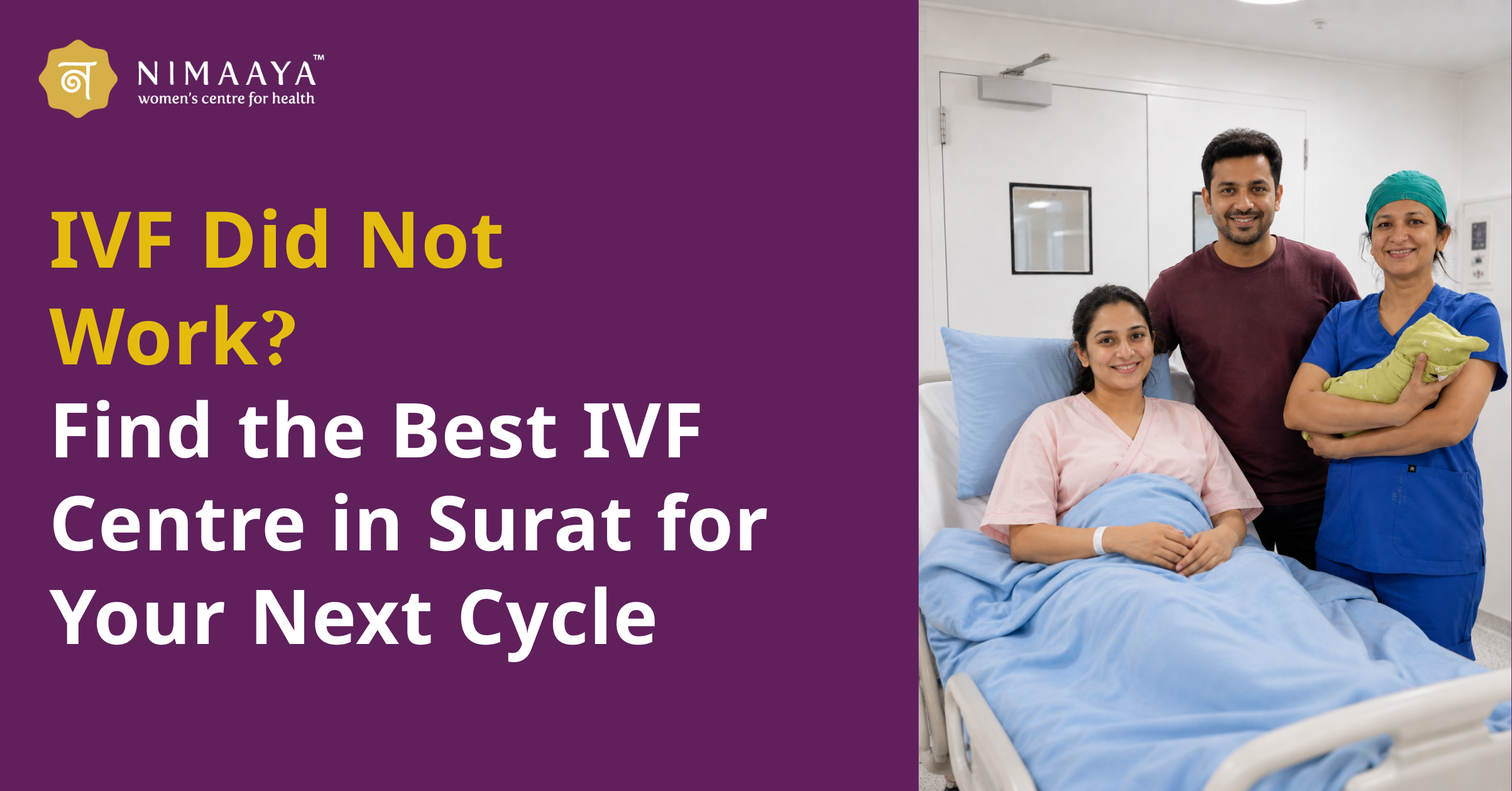
If your IVF cycle did not result in a pregnancy, the grief you are feeling right now is real. It is not just disappointment; it is the weight of hope, time, money, and love that went into something that did not happen the way you needed it to.
You are not alone in this. Roughly 40 to 60 percent of first IVF cycles do not result in a live birth, not because something is wrong with you, but because IVF is a complex biological process with many variables. Most successful pregnancies happen in the second or third cycle, with the right diagnosis and the right team.
In this guide, you will understand exactly why IVF cycles fail, what questions to ask before your next attempt, and what makes one IVF centre meaningfully better than another, specifically if you are in Surat. As a fertility specialist with over 20 years at Nimaaya, I have reviewed hundreds of failed cycles from other clinics and helped those couples find their way to a successful pregnancy.
Why IVF Fails – The Honest Answers You Deserve
One of the most painful parts of a failed cycle is being told “it just did not work this time” with no further explanation. You deserve more than that. IVF failure has identifiable causes in the majority of cases, and knowing yours is the first step toward a different outcome.
IVF failure most commonly occurs due to chromosomally abnormal embryos (50–60% of cases), poor egg or sperm quality, thin or unreceptive uterine lining, implantation failure, or undetected conditions like endometriosis or adenomyosis. A thorough investigation after a failed cycle can identify the cause in most patients and guide the next protocol.
The Most Common Reasons IVF Does Not Work
| Cause of Failure | How Common | Can It Be Addressed? |
| Chromosomally abnormal embryo | 50–60% of failures | Yes — with PGT-A embryo testing |
| Poor egg quality (especially age-related) | 20–30% | Yes — protocol adjustments and donor eggs if needed |
| Poor sperm DNA fragmentation | 15–25% | Yes — ICSI, antioxidant therapy, TESA |
| Thin or unreceptive uterine lining | 10–15% | Yes — ERA test, endometrial priming |
| Undetected endometriosis/adenomyosis | 10–20% | Yes — laparoscopy before next cycle |
| Implantation failure (immune causes) | 10–15% | Yes — immunological workup and modified protocols |
| Suboptimal lab conditions at the previous clinic | Often underreported | Yes — choosing a better-equipped lab |
That last row matters more than most people realise. The IVF laboratory is where your embryo spends its most critical early days. Temperature, humidity, pH, and air quality all affect whether an embryo grows well. Not every clinic in Surat maintains the same standards.
Learn More About Our Service: IVF treatment options in Surat
What Should Have Happened After Your Failed Cycle
A failed IVF cycle is not the end of the investigation; it is data. Your fertility team should have conducted a structured review of what happened at every stage. If they did not, that is important information too.
Here is what a thorough post-failure review looks like at a centre like Nimaaya:
- Embryo quality review — How many eggs were retrieved? How many are fertilised? How many reached the blastocyst stage? What was the grading?
- Sperm DNA fragmentation test — Standard semen analysis is not enough. High DNA fragmentation is a hidden cause of failed cycles that many clinics miss.
- Uterine assessment — Was a hysteroscopy done to rule out polyps, fibroids, or adhesions inside the uterine cavity?
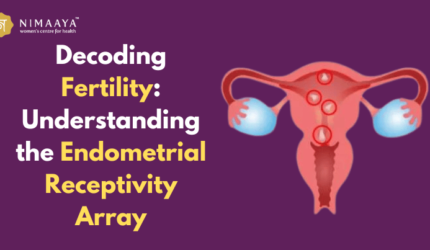
- ERA (Endometrial Receptivity Analysis) — Tests whether your uterine lining was actually receptive on the day of the transfer. Transfers on the wrong day will always fail.
- Immunological workup — Checks for NK cell activity, antiphospholipid antibodies, and other immune factors that reject embryos.
- PGT-A recommendation — Preimplantation Genetic Testing of embryos before transfer to select only chromosomally normal ones.
A NOTE FROM DR. POOJA NADKARNI SINGH
“When couples come to Nimaaya after a failed cycle elsewhere, the most common thing I see is that the investigation after failure was not thorough enough. The couple was given a new protocol without understanding why the first one failed. That is why we always begin with a full case review – not just a new stimulation protocol.”
7 Questions to Ask Before Choosing Your Next IVF Centre in Surat
Choosing where to do your next cycle may be the most important decision in your fertility journey. Here are the seven questions every failed-IVF patient should ask and what good answers look like
When choosing the best IVF centre in Surat after a failed cycle, ask about their embryo freeze-all rates, laboratory air quality standards, blastocyst culture capability, PGT-A availability, ERA testing, post-failure review protocols, and success rates broken down by age group, not overall clinic averages.
| Question to Ask | What a Good Answer Looks Like |
| What is your IVF success rate for my age group? | They give age-specific rates, not a single “overall” number. 75–90% per cycle for under 35 is achievable at top centres. |
| Do you culture embryos to the blastocyst stage (Day 5)? | Yes. Blastocyst transfer has higher success rates than Day 3 transfer. Not all labs can sustain this. |
| Is PGT-A (embryo genetic testing) available here? | Yes, in-house or via certified partner. This is critical for patients over 35 or with repeated failures. |
| What air quality grade is your IVF lab? | ISO Class 5 or better. Volatile organic compounds (VOCs) kill embryos. Most patients never think to ask this. |
| Will you review my previous cycle before starting? | A full case review — not just a glance at the summary — before recommending a new protocol. |
| Do you offer ERA testing for implantation failure? | Yes. If you have had two or more failed transfers, ERA is recommended before the next one. |
| Who performs my egg retrieval and embryo transfer? | The same specialist who planned your cycle. Not a rotating junior doctor. |
What Makes Nimaaya the Best IVF Centre in Surat for Second-Attempt Patients
Nimaaya was founded 30 years ago on Ring Road, Athwagate, Surat, and over those three decades, a significant portion of our patients have been couples who came to us after failed cycles at other clinics. We take that responsibility seriously. Here is specifically what we do differently:
1. We Always Start With a Case Review — Not a New Protocol
Before we recommend any treatment, our team reviews your previous cycle in detail: the stimulation protocol, the embryo development report, the transfer conditions, and the investigation done after failure. Most of the time, we find something that was missed or could be improved.
2. Our IVF Lab Meets International Standards
Our embryology laboratory maintains ISO-standard air quality, HEPA-filtered positive pressure, precise temperature and CO₂ control, and time-lapse embryo monitoring. The embryo you create here is given the best possible environment in its earliest days.
3. Blastocyst Culture and Vitrification as Standard
We culture all embryos to the Day 5 blastocyst stage, where possible, the stage that most closely predicts implantation potential. Our vitrification (fast-freeze) protocol yields frozen embryos with success rates comparable to fresh transfers.
4. PGT-A and ERA Available In-House
Preimplantation Genetic Testing for Aneuploidies (PGT-A) and Endometrial Receptivity Analysis (ERA) are both available at Nimaaya – tests that most failed-IVF patients should have before their next transfer.
5. Named Doctor — Always
Every patient at Nimaaya is managed by a named specialist from the first consultation to embryo transfer. You will not be handed off between rotating doctors on the day that matters most.
| What You Need | Nimaaya’s Approach |
| Understand why previous cycle failed | Full case review before any new protocol is designed |
| Better embryo selection | PGT-A available; blastocyst culture as standard |
| Know if uterus was ready | ERA test + hysteroscopy if not done previously |
| Better lab quality | ISO-standard lab, time-lapse monitoring, vitrification |
| One consistent doctor | Same specialist from consultation to transfer |
| Emotional support during treatment | Dedicated counsellor, Gujarati-speaking staff, no rushed appointments |
| Transparent cost | Full cost breakdown before cycle begins — no hidden charges |
Learn More About: IVF cost at Nimaaya, Surat
A Patient’s Story — Mr and Mrs Ranvir Vasiya’s Third Attempt at Nimaaya
Married for the last 14 years, Mr and Mrs Ranvir Vasiya became proud parents of a baby boy. Anjana was 32 back then and had previously gone through 4 failed IVF cycles, reasons unexplained… but fortunately, in her 5th cycle, she conceived and welcomed this bundle of joy.
In Their Words:
We tried conceiving naturally, but nothing happened. We consulted several IVF clinics in Surat. But we have had several failed IVF results. After my second failure, I was ready to give up. A friend told me to try Nimaaya before making any final decision. Dr. Pooja spent over an hour reviewing my previous records, something no one had done before. She found that I had a uterine polyp that had been missed, and my ERA test showed I needed a displaced transfer window. We corrected both.
Mrs Vasiya’s case is not unusual. The polyp would have shown on a simple saline sonography. A standard test identifies the ERA window shift. Both were missed because no one looked carefully enough after the second failure.
IVF Success Rates at Nimaaya — What the Numbers Mean for You
When a clinic quotes a success rate, always ask: success rate for which patients, in which age group, and measured how – as a positive pregnancy test, a clinical pregnancy (heartbeat on scan), or a live birth? At Nimaaya, our success rates are measured as clinical pregnancy rates per embryo transfer:
| Your Age | IVF Success Rate at Nimaaya (Own Eggs) | With Donor Eggs |
| Under 35 | 82 – 90% per cycle | 88 – 92% |
| 35 – 37 | 72 – 80% | 88 – 92% |
| 38 – 40 | 55 – 65% | 88 – 92% |
| Above 40 | 35 – 50% | 88 – 92% |
| Frozen embryo transfer (FET) | 78 – 85% (age-adjusted) | – |
For failed-IVF patients specifically, our success rate in patients who have had one or more previous failed cycles at other centres is 68–75% within two cycles at Nimaaya. This is because we begin with a thorough investigation rather than simply repeating the same approach.
The best IVF centre in Surat for patients who have had failed IVF cycles conducts a thorough case review; offers PGT-A embryo testing and ERA uterine receptivity analysis; and has a dedicated embryology lab meeting international standards, not simply the clinic with the most advertising.
Frequently Asked Questions
How many IVF cycles does it typically take before success?
Most couples achieve pregnancy within 2–3 IVF cycles. Success rates improve significantly when the cause of previous failure is identified and corrected. At Nimaaya, the best IVF Centre in Surat, 68–75% of patients who have had prior failed cycles conceive within two cycles with us.
Should I get a second opinion after a failed IVF cycle?
Yes – especially if your clinic did not conduct a thorough post-failure review or if the same protocol is being recommended again without explanation. A second opinion costs very little and can change the outcome entirely.
What is ERA testing, and do I need it after a failed IVF?
ERA (Endometrial Receptivity Analysis) is a biopsy test that identifies your exact implantation window—the specific hours when your uterus is receptive to an embryo. If your lining looked fine but the embryo still did not implant, ERA is strongly recommended before your next transfer.
Is PGT-A testing worth it after a failed IVF cycle?
For most patients over 35 in their advanced maternal age or with repeated implantation failure, PGT-A is strongly recommended. It screens embryos for chromosomal abnormalities before transfer, so only viable embryos are transferred. This significantly reduces the chance of another failed cycle.
How long should I wait before trying IVF again after a failure?
Physically, most women can begin a new cycle after one full menstrual cycle (4–6 weeks). Emotionally, take the time you need. More importantly, use the waiting period to complete any investigations: ERA, PGT-A, hysteroscopy, so the next cycle has a better-informed protocol.
What is the IVF cost at Nimaaya, Surat, for a second attempt?
IVF cycles at Nimaaya start from ₹90,000. For failed-IVF patients who need additional investigations (ERA, PGT-A, hysteroscopy), these are priced separately and transparently. We provide a full IVF cost breakdown before your cycle begins – no surprises.
Can I book a second-opinion consultation at Nimaaya without committing to treatment?
Absolutely. A second-opinion consultation at Nimaaya is a full review of your previous cycle reports, investigations, and treatment history. You are under no obligation to begin treatment. Many patients simply want clarity, and that is completely valid.
Is Nimaaya in Surat equipped for complex cases like repeated implantation failure?
Yes. Nimaaya handles complex cases, including repeated implantation failure, poor ovarian response, recurrent pregnancy loss, and severe male factor infertility. Our team includes specialists in embryology, andrology, and reproductive endocrinology.
Your Next Step: Choosing IVF in Surat After Failed IVF
A failed IVF cycle is not a verdict on your ability to become a parent. It is incomplete information. The right team, the right investigation, and a better-designed protocol have helped thousands of couples in exactly your situation go on to have healthy babies. Three things to do right now:
- Gather your previous cycle records: the full embryology report, stimulation protocol, and any investigations done after the failure.
- Book a second-opinion consultation at a centre that will review them carefully, not just start a new protocol.
- Ask the 7 questions from this article before you commit to your next centre or cycle.
At Nimaaya, our first consultation for failed-IVF patients is specifically designed to give you honest answers — not just hope. Call us at +91-261-6119900 or visit nimaaya.com to book your case review.
BOOK YOUR SECOND-OPINION CONSULTATION
Nimaaya IVF & Fertility Centre
· 3rd Floor, Jash Bryant, Opp. Old RTO, Ring Road, Surat 395001
· Phone: +91-261-6119900
· Email: hello@nimaaya.com
· Mon–Sat: · Open 24 Hours:
https://nimaaya.com/best-ivf-center-in-surat/
About the Author
DR. POOJA NADKARNI SINGH — IVF SPECIALIST & REPRODUCTIVE ENDOCRINOLOGIST
MS (Obstetrics & Gynaecology) · Fellowship in Reproductive Medicine Dr. Pooja Nadkarni Singh is the lead IVF specialist at Nimaaya Fertility Centre, Surat, with over 20 years of experience in complex infertility cases, repeated implantation failure, and advanced reproductive medicine. She has overseen thousands of IVF cycles at Nimaaya and leads the clinic’s failed-cycle review programme.